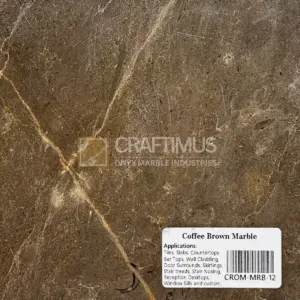
Coffee Brown Marble Uses and Specifications — Factory-Direct Architectural Stone with Custom Fabrication

US$2-3

300 sqft (MOQ)

Custom 3D Designing

Enjoy concepts to 3D Stone Renders with craftimus-onyx-marble.com

Shipping

Shipping Cost: Freight charges, customs clearance, and estimated delivery time are calculated based on your products.

Key Attributes

material

Marble

color_family

Brown

finish

Polished, Honed

application

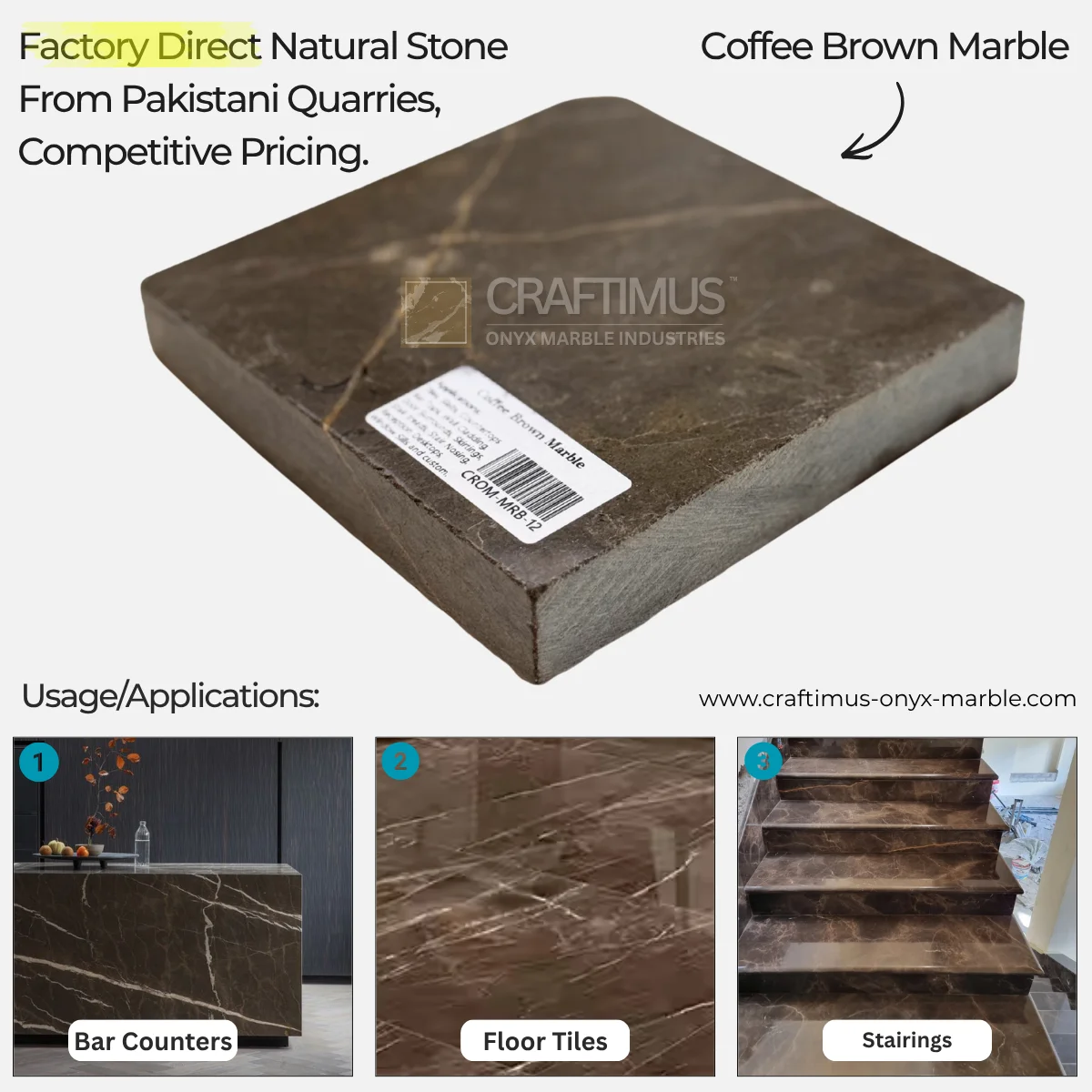
Countertops, Wall Cladding, Bar Tops

origin

Pakistan

availability

In Stock

Order Type

Standard

,

Premium

Sample Servcies

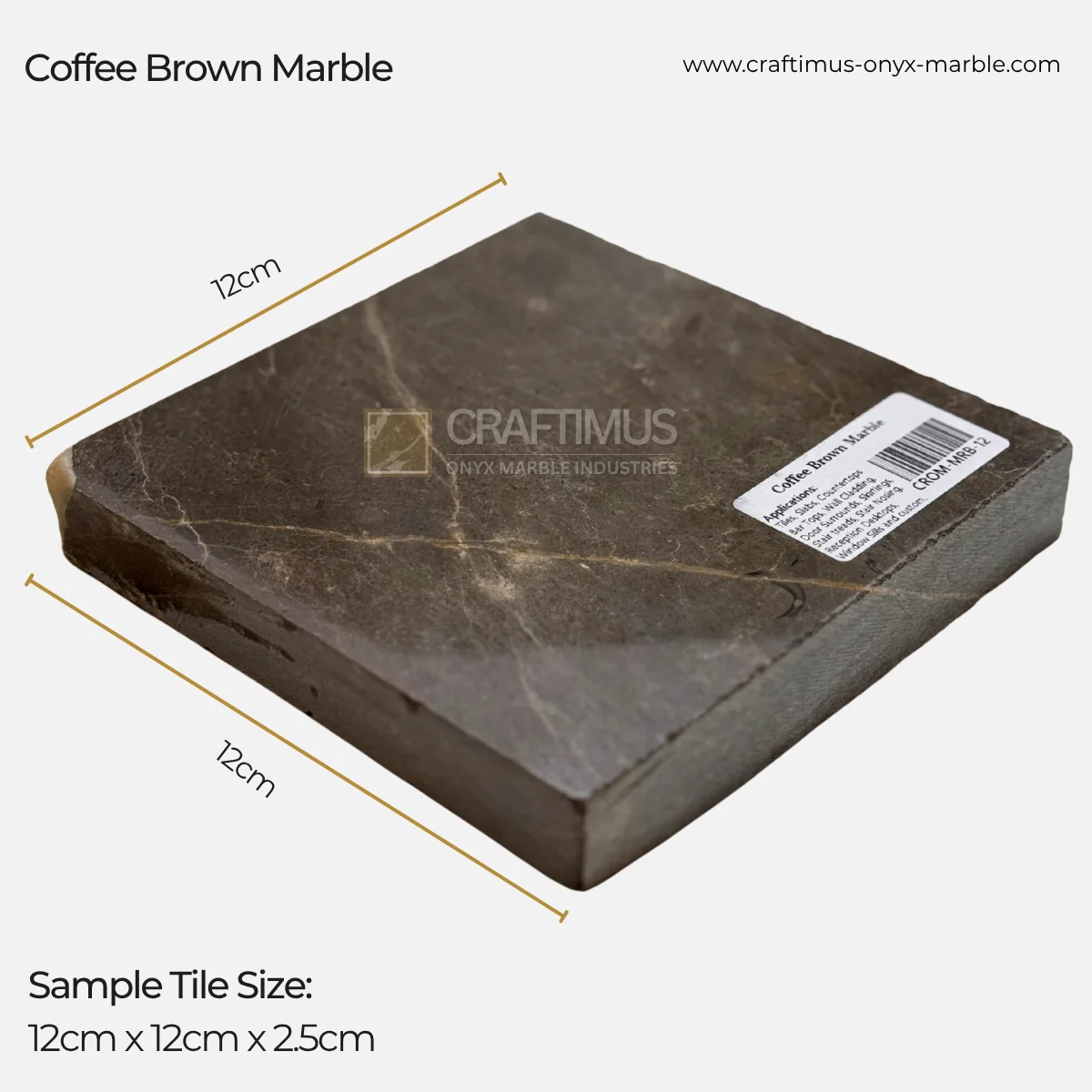
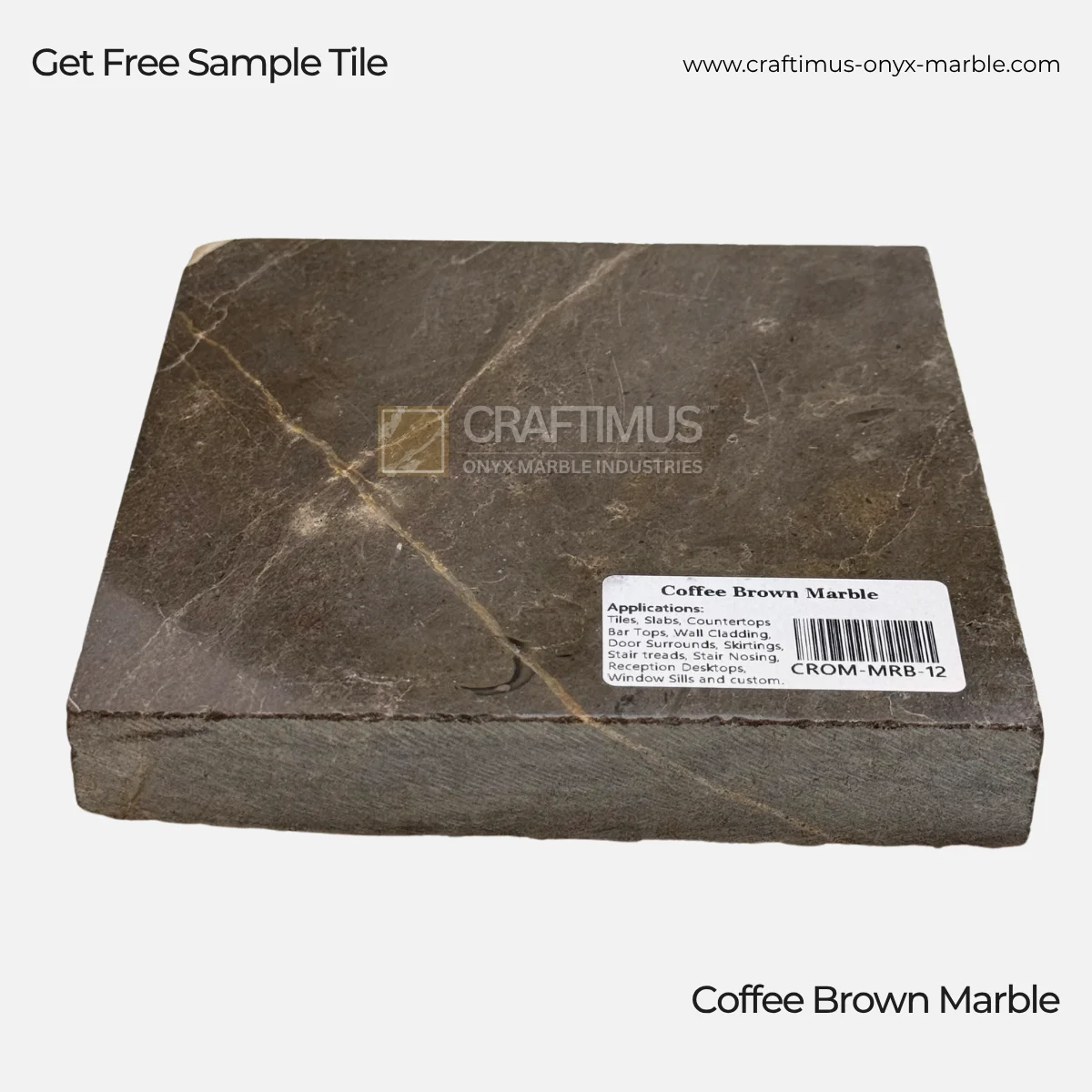
Get samples of US$65.00/Piece!

CRAFTIMUS Onyx Marble Industries, a Stone
Manufacturer & Exporter

Addess

Plot C187, Manghopir Rd, Karachi

International Commercial Terms

FOB, EXW, CIF, DDP

Payment Terms

T/T, PayPal, Western Union, Payoneer, Small Payments

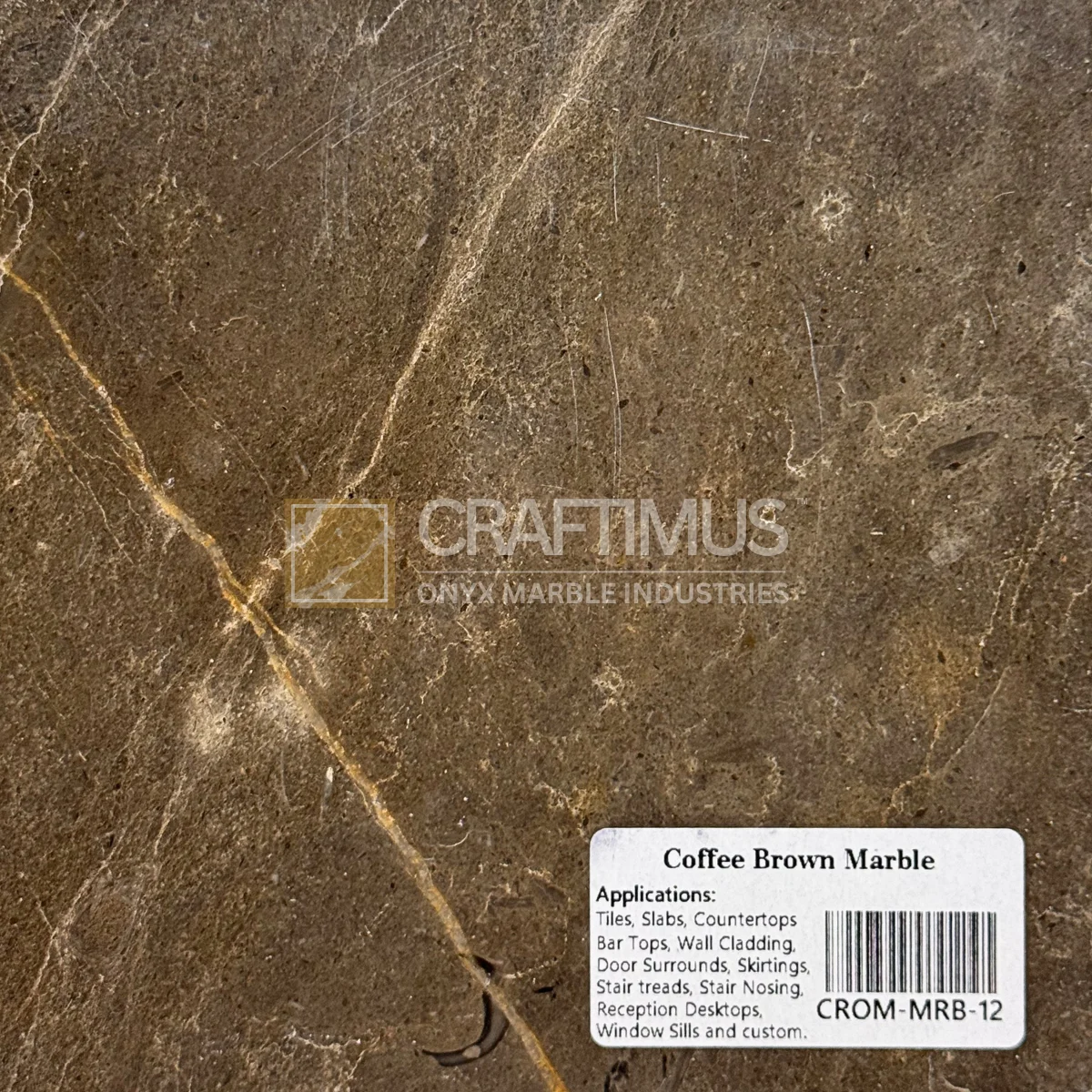
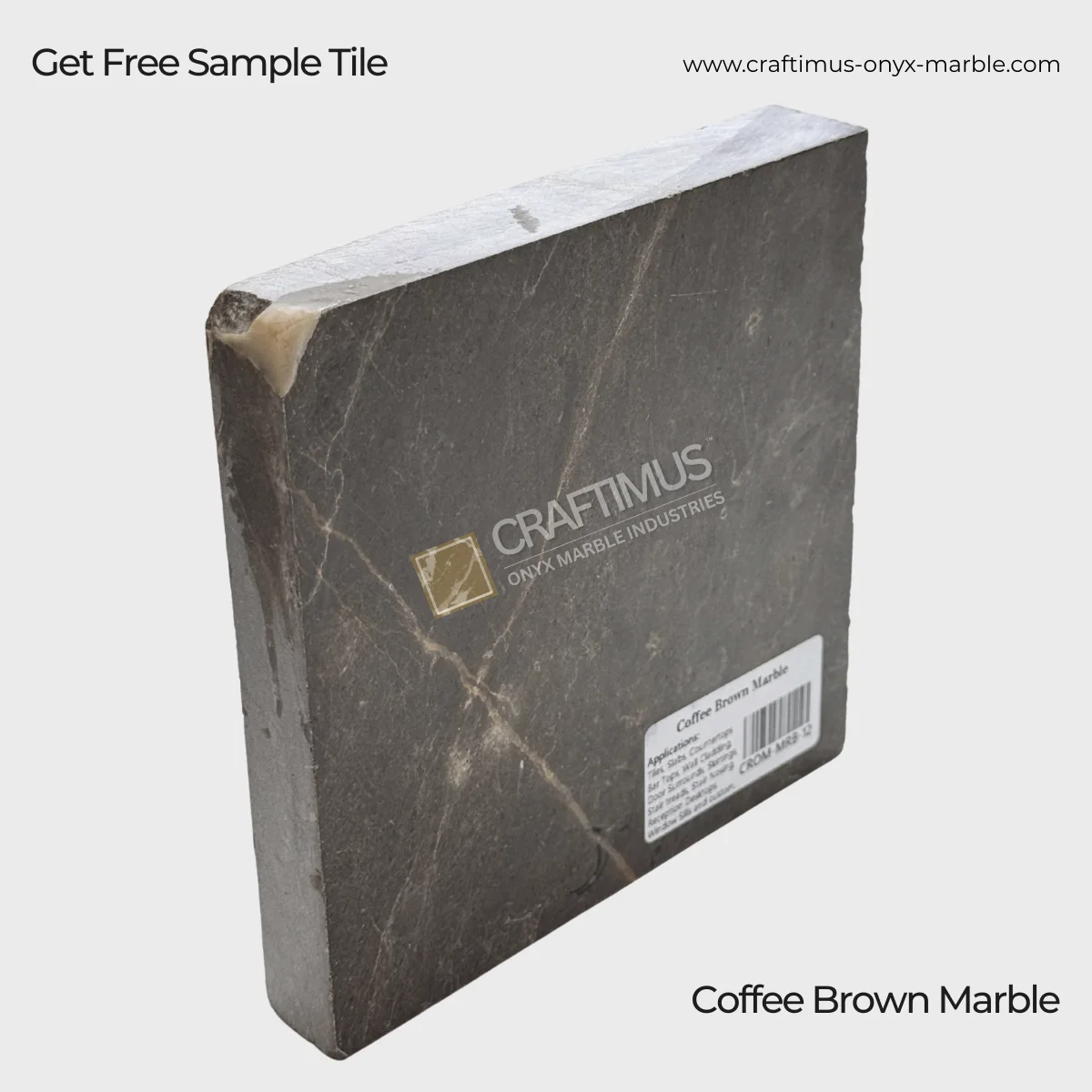
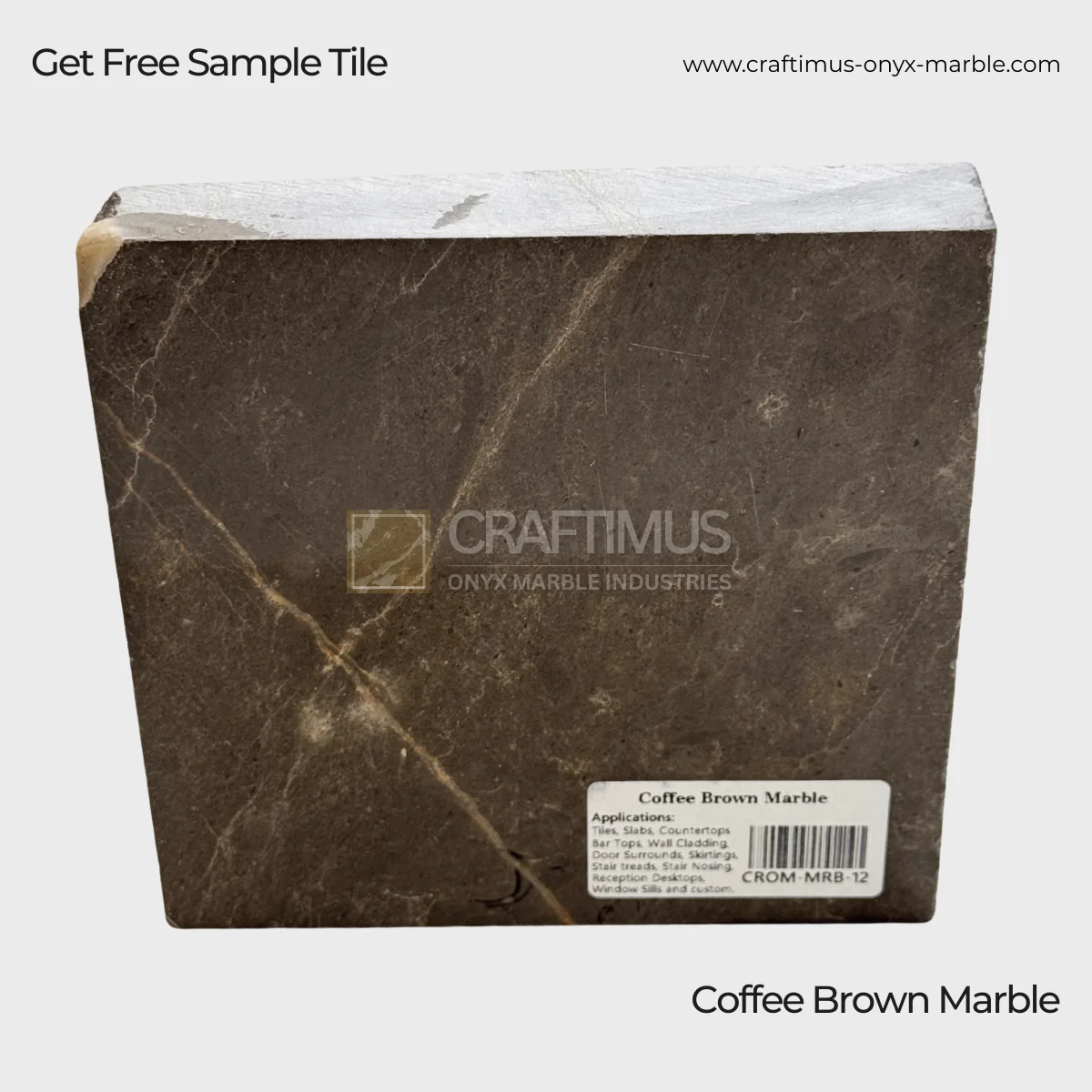
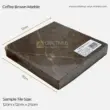
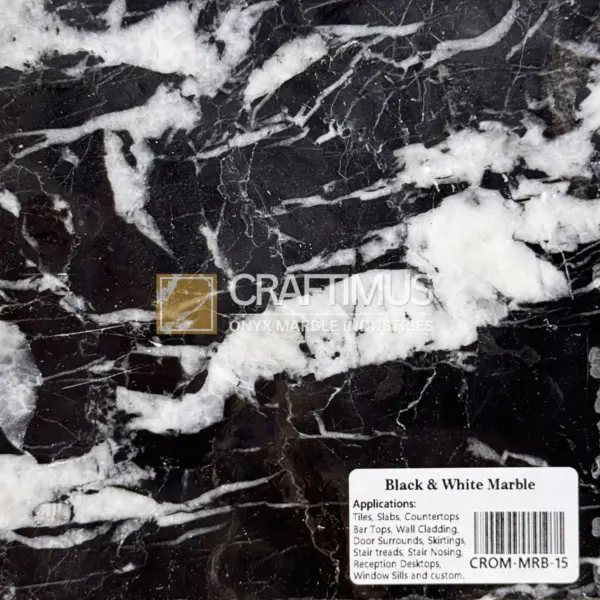
Coffee Brown marble is a naturally veined metamorphic calcite stone from Pakistani quarry regions (Gilgit-Baltistan, Mardan, Buner belts), characterized by deep chocolate-brown background with creamy yellow vein networks. Factory specifications: 3–4 Mohs hardness, 0.6–0.8% water absorption by mass, 2,700 kg/m³ density, 50–100 MPa compressive strength. Available polished (mirror gloss), honed (matte), leathered (textured), or antiqued finish. Custom sizing, CNC edge profiling, book-matching, and 3D rendering service included. Factory-direct pricing eliminates distributor markup.

Geological Identity of Coffee Brown Marble and Pakistani Quarry Origin

Coffee Brown marble is a metamorphic calcite stone, not granite or engineered composite. It forms through recrystallization processes in the Pakistani geological belts spanning Gilgit-Baltistan, Mardan, and Buner regions, where ancient carbonate sediments underwent metamorphic transformation under tectonic pressure and elevated temperature. The stone’s calcite-rich matrix hosts iron oxide and secondary calcite deposits that precipitated within stress fractures during cooling phases, creating the signature yellow vein networks against the coffee-brown host material. These veins are not surface defects but geological identifiers documenting formation history across millions of years.

Quarry extraction occurs in documented deposits where slab consistency and vein architecture meet architectural specification thresholds. The vein pattern is the material’s design signature—a naturally occurring feature that defines each slab’s visual identity and book-matched potential. Coffee Brown marble from Pakistan represents quarry-direct access to this metamorphic calcite variety without distributor intermediaries.

Visual Character and Vein Pattern Specification

The stone presents a deep chocolate-brown calcite base color, cataloged within warm earth tone ranges suitable for contemporary luxury and transitional interior palettes. Creamy yellow vein networks traverse the background in organic patterns formed by iron oxide and calcite precipitation within ancient fracture systems. This vein architecture creates visual depth and thermal warmth that function as the material’s primary design contribution, not a secondary aesthetic feature to minimize.

Vein classification follows two categories: Type A exhibits bold, continuous linear veining ideal for book-matching across consecutive slabs, while Type B displays scattered, varied patterns suited for applications requiring visual diversity. Polished finish enhances vein contrast through mirror gloss, revealing the full depth of the yellow-brown interaction. Honed finish softens the appearance, reducing reflectivity while maintaining vein visibility. Leathered finish adds three-dimensional texture, creating tactile variation that hides fingerprints and wear patterns in high-traffic commercial installations.

Architectural Specification and Commercial Applications

Coffee Brown marble serves as a named specification material in luxury hotel lobbies, where flooring and feature wall installations require durability, thermal stability, and design signature impact. The stone’s warmth positions it within hospitality interiors as an organic counterpoint to cooler gray and white palettes. High-end residential kitchen islands and countertops benefit from custom slab dimensions in standard 2 cm or 3 cm thickness, with thermal expansion coefficient of 4–5 × 10⁻⁶/°C ensuring performance stability under temperature flux from cooking operations.

Bespoke bar installations in restaurant and residential settings utilize the stone’s book-matched continuous vein flow, achieved through precision-honed sequential slab cutting and CNC edge profiling. Available edge treatments include beveled, ogee, and bullnose profiles, fabricated in-house without outsourcing delays. The material’s fabrication tolerance allows for custom waterjet inlay and radius cuts where design complexity demands geometric precision beyond standard rectangular formats.

Commercial interior architects specify Coffee Brown marble for projects requiring ASTM-compliant material documentation, published hardness ratings, and verifiable absorption data. The stone pairs with warm metallics such as brass and copper hardware, cool gray cabinetry, and neutral textile palettes in contemporary and mid-century modern design contexts. Its veining architecture becomes a visual anchor in open-plan spaces where material continuity across horizontal and vertical surfaces establishes spatial coherence.

Technical Specifications and Material Performance Data

Coffee Brown marble is specified using quantifiable material properties that govern installation protocol, maintenance requirements, and long-term performance in commercial and residential environments. The stone’s metamorphic calcite composition yields a Mohs hardness rating of 3–4, positioning it within the marble classification suitable for interior applications where sealing and maintenance prevent surface degradation. Water absorption rate measures 0.6–0.8% by mass under ASTM-compliant testing, requiring penetrating sealer application in wet areas and kitchen installations to mitigate staining and moisture infiltration.

Density measures 2,700 kg/m³ (±50), contributing to structural load calculations for flooring and countertop support systems. Compressive strength ranges from 50–100 MPa, adequate for standard interior loading conditions but requiring engineered support for cantilevered installations exceeding 600 mm overhang. Thermal expansion coefficient of 4–5 × 10⁻⁶/°C ensures dimensional stability under temperature variation, critical for kitchen islands adjacent to cooking surfaces.

Property Specification
Dimensions (mm) Custom sizing available; standard slab sizes 1,000–3,000 mm length × 500–1,800 mm width
Thickness (mm) 20 mm (2 cm), 30 mm (3 cm), custom thickness on request
Weight (kg/m²) 54 kg/m² (20 mm), 81 kg/m² (30 mm)
Surface Finish Polished (mirror gloss), Honed (matte), Leathered (textured), Antiqued (tumbled edge)
Mohs Hardness 3–4 (marble classification, suitable for interior use)
Water Absorption (%) 0.6–0.8% by mass (penetrating sealer required for wet areas)
Density (kg/m³) 2,700 ± 50
Compressive Strength (MPa) 50–100
Thermal Expansion Coefficient (1/°C) 4–5 × 10⁻⁶
ASTM Compliance ASTM C503 (limestone/marble standard)
Vein Pattern Classification Type A (bold, continuous) or Type B (scattered, varied)
Applications Luxury hotel lobbies, high-end residential kitchens, bespoke bar installations, commercial feature walls

Comparative Material Analysis: Coffee Brown Marble vs. Competing Stone Types

Coffee Brown marble from Pakistani quarries competes directly with Dark Emperador from Spanish deposits, where factory-direct pricing provides 40–60% cost advantage over distributor-sourced imports. Dark Emperador presents higher visual consistency with uniform brown tones but lacks the organic yellow vein contrast that defines Coffee Brown’s design signature. Both stones share similar Mohs hardness (3–4) and absorption rates, but Coffee Brown offers superior availability in large-format slabs due to quarry access and fabrication capacity.

Giallo Atlantide, an Italian marble with warmer yellow-gold tones, commands premium pricing due to European sourcing logistics and limited quarry output. Coffee Brown provides comparable warmth at reduced cost, with deeper brown saturation that accommodates darker interior palettes. Portoro marble, featuring black background with gold veining, occupies a higher price tier but serves different aesthetic intentions—its high contrast suits dramatic design statements, while Coffee Brown integrates as a warm foundational material.

Coffee Brown granite represents a different material class with Mohs hardness 6–7, lower water absorption, and crystalline structure lacking the veining individuality of metamorphic marble. Architects specify marble over granite for luxury interiors requiring softer aesthetic qualities, vein-driven visual interest, and the design malleability that calcite-based stone provides. Factory-direct sourcing from Pakistani quarries removes distributor markup, making Coffee Brown marble cost-competitive with engineered quartz while delivering geological authenticity and natural variation.

Installation Protocol and Maintenance Specification

Substrate preparation requires engineered plywood or cement backer board with moisture barrier in wet applications, ensuring dimensional stability beneath the marble installation. Thin-set mortar must be pH-neutral and marble-compatible, avoiding acidic formulations that degrade calcite over time. Grout joints should be sealed separately using penetrating sealer rated for calcite absorption rates.

Post-installation sealing is mandatory, using penetrating sealer that infiltrates the stone’s porosity without leaving surface film. Polished finishes require annual re-sealing in residential kitchens; honed finishes benefit from bi-annual maintenance due to higher exposed porosity. Cleaning protocol mandates pH-neutral, marble-safe cleaners—acidic solutions including vinegar and citrus-based products cause calcite etching and irreversible surface damage.

Thermal shock prevention in kitchen installations requires trivets and heat pads beneath hot cookware, as rapid temperature change can induce microfractures despite the stone’s published thermal expansion coefficient. Edge treatment preservation varies by profile: beveled edges resist chipping; ogee and bullnose profiles require maintenance vigilance in high-traffic zones. Honed edges show wear patterns faster than polished edges due to surface texture retaining micro-abrasions.

CRAFTIMUS Quarry-Direct Manufacturing and Architect Services

CRAFTIMUS operates factory-direct supply chains from Pakistani quarry regions to global markets, eliminating distributor intermediaries that typically add 40–60% markup to imported stone pricing. This vertical integration includes quarry access agreements, in-house fabrication facilities with CNC profiling capacity, and export logistics infrastructure handling crating, documentation, and compliance verification. Architects and commercial specifiers receive direct access to materials engineers who provide technical specification sheets, absorption testing data, and finish verification documentation per slab.

The 3D rendering and digital visualization service allows architects to preview final installations before fabrication commitment, reducing specification risk in high-value projects. Custom slab dimensions beyond industry-standard formats accommodate bespoke design requirements, including book-matching for continuous vein flow across multi-piece installations. Type A bold vein patterns are prioritized for book-matching applications where sequential slab cutting maintains linear continuity.

Quality certification accompanies each slab, documenting Mohs hardness, water absorption percentage, density measurement, and finish type. Wholesale bulk ordering follows tiered pricing structures with published minimum order quantities (MOQ), enabling developers and importers to negotiate volume-based cost reductions. Export-ready packaging includes reinforced crating rated for international shipping, with customs documentation and material safety data sheets (MSDS) provided per destination market requirements.

Frequently Asked Questions

What is the rarest color of marble, and where does Coffee Brown rank?

Coffee Brown marble is a naturally occurring geological variety from Pakistani quarries, not a rare engineered product. Rarity in marble specification relates to vein pattern consistency rather than base color—Type A bold, continuous veining in large-format slabs commands premium pricing due to limited quarry availability. The stone’s geological scarcity is moderate; its specification value derives from factory-direct access and fabrication services that competitors sourcing through distributors cannot match economically.

What shade is Coffee Brown marble, and how does it perform in modern interior design?

Coffee Brown marble presents a deep chocolate-brown calcite base with creamy yellow vein networks, cataloged within warm earth tone ranges. The shade performs optimally in luxury hospitality interiors, high-end residential kitchens, and contemporary commercial spaces requiring organic warmth. Design versatility allows pairing with warm metallics like brass and copper, cool gray cabinetry, and neutral textile palettes. Thermal stability specifications (4–5 × 10⁻⁶/°C thermal expansion) and durability metrics support high-traffic commercial applications where material longevity is critical.

Where does Coffee Brown marble come from, and why is factory-direct sourcing cheaper?

Coffee Brown marble originates from Pakistani quarry regions including Gilgit-Baltistan, Mardan, and Buner stone belts, where metamorphic calcite deposits meet architectural specification standards. Factory-direct sourcing from CRAFTIMUS eliminates distributor middlemen who typically add 40–60% markup to imported stone costs. Direct quarry relationships and in-house CNC fabrication facilities enable custom sizing, edge profiling, book-matching, and 3D rendering services without outsourcing delays. Export-ready packaging, compliance documentation, and quality certification are handled internally, reducing per-unit cost while maintaining specification-grade material delivery.

What color does Coffee Brown marble go with, and what finishes are available?

Coffee Brown marble pairs with warm metals including brass and copper hardware, cool gray wall finishes, white cabinetry, and earth-tone textile elements. Four finish options accommodate diverse design intentions: polished finish delivers mirror gloss with high vein contrast visibility; honed finish provides matte surface with slip resistance suitable for flooring; leathered finish adds three-dimensional texture that conceals fingerprints and wear patterns; antiqued finish features tumbled edges for aged aesthetic in rustic or transitional interiors. Each finish affects maintenance frequency—polished surfaces require more frequent sealing than honed or leathered alternatives.

What are the technical specifications of Coffee Brown marble for kitchen and commercial use?

Coffee Brown marble specifications include Mohs hardness 3–4, suitable for interior applications with mandatory sealing in wet areas. Water absorption measures 0.6–0.8% by mass under ASTM C503 testing, requiring penetrating sealer for kitchen countertops and bathroom installations. Density reaches 2,700 kg/m³; compressive strength spans 50–100 MPa, adequate for standard loading conditions. Thermal expansion coefficient of 4–5 × 10⁻⁶/°C ensures dimensional stability under temperature flux from cooking operations. Standard thickness options include 2 cm and 3 cm, with custom sizing available for bespoke architectural applications requiring non-standard dimensions.

Does CRAFTIMUS offer custom sizing, 3D rendering, and book-matching for Coffee Brown marble?

CRAFTIMUS provides custom slab dimensions beyond industry-standard formats, accommodating architectural specifications requiring non-rectangular geometries or oversized single-piece installations. The 3D rendering and digital visualization service enables architects to preview final installations before fabrication commitment, reducing specification risk in high-value commercial projects. Book-matching service ensures continuous vein flow across consecutive slabs, with Type A bold vein patterns prioritized for linear continuity. In-house CNC fabrication handles beveled, ogee, and bullnose edge profiling without outsourcing delays. Quality certificates document hardness, absorption rate, and finish verification per slab, with technical specification sheets available on request.

Request Custom Slab Dimensions, 3D Rendering, and Factory-Direct Pricing

Commercial interior architects and hospitality designers specifying Coffee Brown marble for luxury hotel lobbies, high-end residential kitchens, or bespoke bar installations can request custom slab dimensions, 3D rendering consultation, and factory-direct pricing quotes by submitting project scope details. Include project name, installation location, total square footage, preferred finish type (polished, honed, leathered, or antiqued), edge profile requirements, and project timeline. CRAFTIMUS materials engineers respond within 24–48 hours with technical specification sheets, absorption testing data, and tiered pricing structures for bulk orders.

Lead capture forms collect essential project parameters to ensure accurate quotations aligned with architectural specifications. Factory-direct pricing eliminates distributor markup, providing 40–60% cost savings compared to imported competitors. Wholesale inquiries and minimum order quantity (MOQ) discussions are handled through dedicated account managers who coordinate export logistics, customs documentation, and delivery scheduling. Technical specification sheet downloads are available for preliminary design review and material comparison analysis before formal quotation requests.

Coffee Brown Marble Uses and Specifications — Factory-Direct Architectural Stone with Custom Fabrication

US$2-3

300 sqft (MOQ)
Still deciding? Get samples of US$ 9.9/PieceOrder Sample
Product Details
material

Marble

color_family

Brown

finish

Polished, Honed

application

Countertops, Wall Cladding, Bar Tops

origin

Pakistan

availability

In Stock

Order Type

Standard

,

Premium

Shipping
Shipping Cost:                                 Contact the company about freight, customs                                                                             and estimated delivery time.
Payment Security

Payment Methods

Created with Sketch.
4
1

Secured Payment

Every Payment you make to craftimus-onyx-marble are secured and protected

Refund Policy

Claim refunds if your goods are not shipped one time or the product was damaged 

Stone Manufacturer / Exporter

Custom Stone Fabrication & 3D Design Visualization

End-to-End Process Handling Services

Authentic Supplier | Trusted by contractors and designers across 50+ countries for over three decades

31+ Years of Export Experience
Self Branded
Quality Assurance

Basic Information

material
Marble
color_family
Brown
finish
Polished, Honed
application
Countertops, Wall Cladding, Bar Tops
origin
Pakistan
availability
In Stock
Order Type
Standard, Premium

Shipment Size & Delivery

Package Size
N/A

Product Detailed Description

Description
Coffee Brown marble is a naturally veined metamorphic calcite stone from Pakistani quarry regions (Gilgit-Baltistan, Mardan, Buner belts), characterized by deep chocolate-brown background with creamy yellow vein networks. Factory specifications: 3–4 Mohs hardness, 0.6–0.8% water absorption by mass, 2,700 kg/m³ density, 50–100 MPa compressive strength. Available polished (mirror gloss), honed (matte), leathered (textured), or antiqued finish. Custom sizing, CNC edge profiling, book-matching, and 3D rendering service included. Factory-direct pricing eliminates distributor markup.

Geological Identity of Coffee Brown Marble and Pakistani Quarry Origin

Coffee Brown marble is a metamorphic calcite stone, not granite or engineered composite. It forms through recrystallization processes in the Pakistani geological belts spanning Gilgit-Baltistan, Mardan, and Buner regions, where ancient carbonate sediments underwent metamorphic transformation under tectonic pressure and elevated temperature. The stone’s calcite-rich matrix hosts iron oxide and secondary calcite deposits that precipitated within stress fractures during cooling phases, creating the signature yellow vein networks against the coffee-brown host material. These veins are not surface defects but geological identifiers documenting formation history across millions of years.

Quarry extraction occurs in documented deposits where slab consistency and vein architecture meet architectural specification thresholds. The vein pattern is the material’s design signature—a naturally occurring feature that defines each slab’s visual identity and book-matched potential. Coffee Brown marble from Pakistan represents quarry-direct access to this metamorphic calcite variety without distributor intermediaries.

Visual Character and Vein Pattern Specification

The stone presents a deep chocolate-brown calcite base color, cataloged within warm earth tone ranges suitable for contemporary luxury and transitional interior palettes. Creamy yellow vein networks traverse the background in organic patterns formed by iron oxide and calcite precipitation within ancient fracture systems. This vein architecture creates visual depth and thermal warmth that function as the material’s primary design contribution, not a secondary aesthetic feature to minimize.

Vein classification follows two categories: Type A exhibits bold, continuous linear veining ideal for book-matching across consecutive slabs, while Type B displays scattered, varied patterns suited for applications requiring visual diversity. Polished finish enhances vein contrast through mirror gloss, revealing the full depth of the yellow-brown interaction. Honed finish softens the appearance, reducing reflectivity while maintaining vein visibility. Leathered finish adds three-dimensional texture, creating tactile variation that hides fingerprints and wear patterns in high-traffic commercial installations.

Architectural Specification and Commercial Applications

Coffee Brown marble serves as a named specification material in luxury hotel lobbies, where flooring and feature wall installations require durability, thermal stability, and design signature impact. The stone’s warmth positions it within hospitality interiors as an organic counterpoint to cooler gray and white palettes. High-end residential kitchen islands and countertops benefit from custom slab dimensions in standard 2 cm or 3 cm thickness, with thermal expansion coefficient of 4–5 × 10⁻⁶/°C ensuring performance stability under temperature flux from cooking operations.

Bespoke bar installations in restaurant and residential settings utilize the stone’s book-matched continuous vein flow, achieved through precision-honed sequential slab cutting and CNC edge profiling. Available edge treatments include beveled, ogee, and bullnose profiles, fabricated in-house without outsourcing delays. The material’s fabrication tolerance allows for custom waterjet inlay and radius cuts where design complexity demands geometric precision beyond standard rectangular formats.

Commercial interior architects specify Coffee Brown marble for projects requiring ASTM-compliant material documentation, published hardness ratings, and verifiable absorption data. The stone pairs with warm metallics such as brass and copper hardware, cool gray cabinetry, and neutral textile palettes in contemporary and mid-century modern design contexts. Its veining architecture becomes a visual anchor in open-plan spaces where material continuity across horizontal and vertical surfaces establishes spatial coherence.

Technical Specifications and Material Performance Data

Coffee Brown marble is specified using quantifiable material properties that govern installation protocol, maintenance requirements, and long-term performance in commercial and residential environments. The stone’s metamorphic calcite composition yields a Mohs hardness rating of 3–4, positioning it within the marble classification suitable for interior applications where sealing and maintenance prevent surface degradation. Water absorption rate measures 0.6–0.8% by mass under ASTM-compliant testing, requiring penetrating sealer application in wet areas and kitchen installations to mitigate staining and moisture infiltration.

Density measures 2,700 kg/m³ (±50), contributing to structural load calculations for flooring and countertop support systems. Compressive strength ranges from 50–100 MPa, adequate for standard interior loading conditions but requiring engineered support for cantilevered installations exceeding 600 mm overhang. Thermal expansion coefficient of 4–5 × 10⁻⁶/°C ensures dimensional stability under temperature variation, critical for kitchen islands adjacent to cooking surfaces.

Property Specification
Dimensions (mm) Custom sizing available; standard slab sizes 1,000–3,000 mm length × 500–1,800 mm width
Thickness (mm) 20 mm (2 cm), 30 mm (3 cm), custom thickness on request
Weight (kg/m²) 54 kg/m² (20 mm), 81 kg/m² (30 mm)
Surface Finish Polished (mirror gloss), Honed (matte), Leathered (textured), Antiqued (tumbled edge)
Mohs Hardness 3–4 (marble classification, suitable for interior use)
Water Absorption (%) 0.6–0.8% by mass (penetrating sealer required for wet areas)
Density (kg/m³) 2,700 ± 50
Compressive Strength (MPa) 50–100
Thermal Expansion Coefficient (1/°C) 4–5 × 10⁻⁶
ASTM Compliance ASTM C503 (limestone/marble standard)
Vein Pattern Classification Type A (bold, continuous) or Type B (scattered, varied)
Applications Luxury hotel lobbies, high-end residential kitchens, bespoke bar installations, commercial feature walls

Comparative Material Analysis: Coffee Brown Marble vs. Competing Stone Types

Coffee Brown marble from Pakistani quarries competes directly with Dark Emperador from Spanish deposits, where factory-direct pricing provides 40–60% cost advantage over distributor-sourced imports. Dark Emperador presents higher visual consistency with uniform brown tones but lacks the organic yellow vein contrast that defines Coffee Brown’s design signature. Both stones share similar Mohs hardness (3–4) and absorption rates, but Coffee Brown offers superior availability in large-format slabs due to quarry access and fabrication capacity.

Giallo Atlantide, an Italian marble with warmer yellow-gold tones, commands premium pricing due to European sourcing logistics and limited quarry output. Coffee Brown provides comparable warmth at reduced cost, with deeper brown saturation that accommodates darker interior palettes. Portoro marble, featuring black background with gold veining, occupies a higher price tier but serves different aesthetic intentions—its high contrast suits dramatic design statements, while Coffee Brown integrates as a warm foundational material.

Coffee Brown granite represents a different material class with Mohs hardness 6–7, lower water absorption, and crystalline structure lacking the veining individuality of metamorphic marble. Architects specify marble over granite for luxury interiors requiring softer aesthetic qualities, vein-driven visual interest, and the design malleability that calcite-based stone provides. Factory-direct sourcing from Pakistani quarries removes distributor markup, making Coffee Brown marble cost-competitive with engineered quartz while delivering geological authenticity and natural variation.

Installation Protocol and Maintenance Specification

Substrate preparation requires engineered plywood or cement backer board with moisture barrier in wet applications, ensuring dimensional stability beneath the marble installation. Thin-set mortar must be pH-neutral and marble-compatible, avoiding acidic formulations that degrade calcite over time. Grout joints should be sealed separately using penetrating sealer rated for calcite absorption rates.

Post-installation sealing is mandatory, using penetrating sealer that infiltrates the stone’s porosity without leaving surface film. Polished finishes require annual re-sealing in residential kitchens; honed finishes benefit from bi-annual maintenance due to higher exposed porosity. Cleaning protocol mandates pH-neutral, marble-safe cleaners—acidic solutions including vinegar and citrus-based products cause calcite etching and irreversible surface damage.

Thermal shock prevention in kitchen installations requires trivets and heat pads beneath hot cookware, as rapid temperature change can induce microfractures despite the stone’s published thermal expansion coefficient. Edge treatment preservation varies by profile: beveled edges resist chipping; ogee and bullnose profiles require maintenance vigilance in high-traffic zones. Honed edges show wear patterns faster than polished edges due to surface texture retaining micro-abrasions.

CRAFTIMUS Quarry-Direct Manufacturing and Architect Services

CRAFTIMUS operates factory-direct supply chains from Pakistani quarry regions to global markets, eliminating distributor intermediaries that typically add 40–60% markup to imported stone pricing. This vertical integration includes quarry access agreements, in-house fabrication facilities with CNC profiling capacity, and export logistics infrastructure handling crating, documentation, and compliance verification. Architects and commercial specifiers receive direct access to materials engineers who provide technical specification sheets, absorption testing data, and finish verification documentation per slab.

The 3D rendering and digital visualization service allows architects to preview final installations before fabrication commitment, reducing specification risk in high-value projects. Custom slab dimensions beyond industry-standard formats accommodate bespoke design requirements, including book-matching for continuous vein flow across multi-piece installations. Type A bold vein patterns are prioritized for book-matching applications where sequential slab cutting maintains linear continuity.

Quality certification accompanies each slab, documenting Mohs hardness, water absorption percentage, density measurement, and finish type. Wholesale bulk ordering follows tiered pricing structures with published minimum order quantities (MOQ), enabling developers and importers to negotiate volume-based cost reductions. Export-ready packaging includes reinforced crating rated for international shipping, with customs documentation and material safety data sheets (MSDS) provided per destination market requirements.

Frequently Asked Questions

What is the rarest color of marble, and where does Coffee Brown rank?

Coffee Brown marble is a naturally occurring geological variety from Pakistani quarries, not a rare engineered product. Rarity in marble specification relates to vein pattern consistency rather than base color—Type A bold, continuous veining in large-format slabs commands premium pricing due to limited quarry availability. The stone’s geological scarcity is moderate; its specification value derives from factory-direct access and fabrication services that competitors sourcing through distributors cannot match economically.

What shade is Coffee Brown marble, and how does it perform in modern interior design?

Coffee Brown marble presents a deep chocolate-brown calcite base with creamy yellow vein networks, cataloged within warm earth tone ranges. The shade performs optimally in luxury hospitality interiors, high-end residential kitchens, and contemporary commercial spaces requiring organic warmth. Design versatility allows pairing with warm metallics like brass and copper, cool gray cabinetry, and neutral textile palettes. Thermal stability specifications (4–5 × 10⁻⁶/°C thermal expansion) and durability metrics support high-traffic commercial applications where material longevity is critical.

Where does Coffee Brown marble come from, and why is factory-direct sourcing cheaper?

Coffee Brown marble originates from Pakistani quarry regions including Gilgit-Baltistan, Mardan, and Buner stone belts, where metamorphic calcite deposits meet architectural specification standards. Factory-direct sourcing from CRAFTIMUS eliminates distributor middlemen who typically add 40–60% markup to imported stone costs. Direct quarry relationships and in-house CNC fabrication facilities enable custom sizing, edge profiling, book-matching, and 3D rendering services without outsourcing delays. Export-ready packaging, compliance documentation, and quality certification are handled internally, reducing per-unit cost while maintaining specification-grade material delivery.

What color does Coffee Brown marble go with, and what finishes are available?

Coffee Brown marble pairs with warm metals including brass and copper hardware, cool gray wall finishes, white cabinetry, and earth-tone textile elements. Four finish options accommodate diverse design intentions: polished finish delivers mirror gloss with high vein contrast visibility; honed finish provides matte surface with slip resistance suitable for flooring; leathered finish adds three-dimensional texture that conceals fingerprints and wear patterns; antiqued finish features tumbled edges for aged aesthetic in rustic or transitional interiors. Each finish affects maintenance frequency—polished surfaces require more frequent sealing than honed or leathered alternatives.

What are the technical specifications of Coffee Brown marble for kitchen and commercial use?

Coffee Brown marble specifications include Mohs hardness 3–4, suitable for interior applications with mandatory sealing in wet areas. Water absorption measures 0.6–0.8% by mass under ASTM C503 testing, requiring penetrating sealer for kitchen countertops and bathroom installations. Density reaches 2,700 kg/m³; compressive strength spans 50–100 MPa, adequate for standard loading conditions. Thermal expansion coefficient of 4–5 × 10⁻⁶/°C ensures dimensional stability under temperature flux from cooking operations. Standard thickness options include 2 cm and 3 cm, with custom sizing available for bespoke architectural applications requiring non-standard dimensions.

Does CRAFTIMUS offer custom sizing, 3D rendering, and book-matching for Coffee Brown marble?

CRAFTIMUS provides custom slab dimensions beyond industry-standard formats, accommodating architectural specifications requiring non-rectangular geometries or oversized single-piece installations. The 3D rendering and digital visualization service enables architects to preview final installations before fabrication commitment, reducing specification risk in high-value commercial projects. Book-matching service ensures continuous vein flow across consecutive slabs, with Type A bold vein patterns prioritized for linear continuity. In-house CNC fabrication handles beveled, ogee, and bullnose edge profiling without outsourcing delays. Quality certificates document hardness, absorption rate, and finish verification per slab, with technical specification sheets available on request.

Request Custom Slab Dimensions, 3D Rendering, and Factory-Direct Pricing

Commercial interior architects and hospitality designers specifying Coffee Brown marble for luxury hotel lobbies, high-end residential kitchens, or bespoke bar installations can request custom slab dimensions, 3D rendering consultation, and factory-direct pricing quotes by submitting project scope details. Include project name, installation location, total square footage, preferred finish type (polished, honed, leathered, or antiqued), edge profile requirements, and project timeline. CRAFTIMUS materials engineers respond within 24–48 hours with technical specification sheets, absorption testing data, and tiered pricing structures for bulk orders.

Lead capture forms collect essential project parameters to ensure accurate quotations aligned with architectural specifications. Factory-direct pricing eliminates distributor markup, providing 40–60% cost savings compared to imported competitors. Wholesale inquiries and minimum order quantity (MOQ) discussions are handled through dedicated account managers who coordinate export logistics, customs documentation, and delivery scheduling. Technical specification sheet downloads are available for preliminary design review and material comparison analysis before formal quotation requests.

Additional information
material

Marble

color_family

Brown

finish

Polished, Honed

application

Countertops, Wall Cladding, Bar Tops

origin

Pakistan

availability

In Stock

Order Type

Standard

,

Premium

Reviews (0)
0 reviews
0
0
0
0
0

There are no reviews yet.

Be the first to review “Coffee Brown Marble Uses and Specifications — Factory-Direct Architectural Stone with Custom Fabrication”

CRAFTIMUS Onyx Marble In..

Coffee brown marble slab ideal for tiles, countertops, and wall cladding applications.
Coffee Brown Marble Uses and Specifications — Factory-Direct Architectural Stone with Custom Fabrication

US$2-3