

Blog
Onyx Marble Manufacturer in Pakistan | CRAFTIMUS

Onyx Marble Manufacturer in Pakistan: CRAFTIMUS Direct-Export Factory with Verified Sourcing & Architect-Grade Documentation
CRAFTIMUS Onyx Marble Industries is a direct-manufacturer and exporter of onyx marble in Pakistan, supplying polished, honed, and leather-brushed slabs to commercial buyers across the USA, UK, European Union, Gulf Cooperation Council, Cyprus, and Spain. Pakistan holds the world’s second-largest marble and granite reserves — an estimated 300 million tons across Balochistan and Khyber Pakhtunkhwa — and CRAFTIMUS sources exclusively from verified quarry operations within these regions. Buyers receive factory pricing with no trading-house markup, full material traceability, ISO 9001-aligned quality management, and export documentation calibrated to destination customs requirements. This page provides the specification-level detail procurement officers and project architects require before issuing a supply order.
What Is Onyx Marble and Why Pakistan Leads Global Supply
Pakistan’s Marble and Granite Reserves: Scale and Regional Sourcing Advantage
Pakistan’s documented marble and granite deposits exceed 300 million tons, distributed primarily across Balochistan and the Khyber Pakhtunkhwa marble belt. These two provinces account for the majority of commercially viable onyx extraction in the country. The geological conditions in Balochistan — specifically the mineralisation patterns that produce translucent calcium carbonate formations — make it one of the few regions worldwide capable of consistently supplying export-grade green onyx at commercial volume.
The Khyber Pakhtunkhwa belt contributes additional variety depth, including white marble, grey-veined material, and supplementary onyx formations. Together, both sourcing regions give Pakistan a supply breadth that neither Turkey nor Italy can match at equivalent price points.
Onyx Marble: Composition, Properties, and Architectural Applications
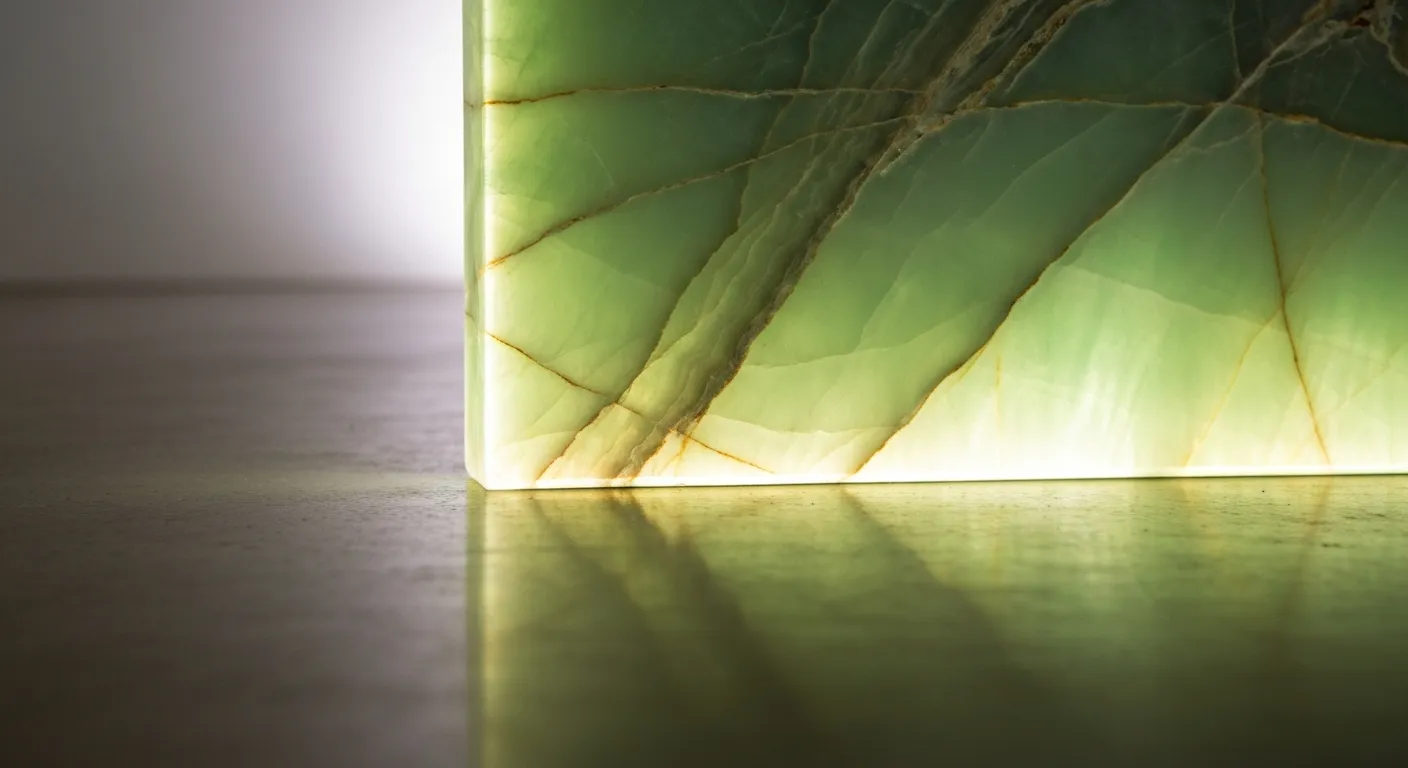
Onyx marble is a banded form of calcium carbonate, distinguished from standard marble by its translucency, tight banding, and capacity to transmit light. Light transmittance refers to the percentage of incident light passing through the slab — a property distinct from surface gloss, which governs reflection at the polished face, and from light diffusion, which describes how that transmitted light scatters internally through the stone’s mineral structure. Slab thickness directly determines light transmittance: at 10mm to 20mm, onyx marble transmits between 30% and 70% of incident light, making it the material of choice for backlit feature walls, illuminated countertops, and luxury retail display panels. These properties are not replicable with any opaque natural stone alternative.
For non-backlit applications — flooring, wall cladding, reception desk surfaces — onyx delivers a visual depth and veining pattern that specifiers use to differentiate premium hospitality and high-end residential interiors. Explore the full range of available formats in the CRAFTIMUS onyx slabs product category.
Cost Positioning: Pakistani Onyx vs. Turkish and Italian Marble
At equivalent slab thickness — 18mm to 30mm — Pakistani onyx marble trades at a 30% to 50% cost advantage over comparable Turkish or Italian onyx varieties, before shipping is factored in. This differential is structural, not cyclical. Lower extraction costs, shorter inland logistics to Karachi port, and a direct manufacturer-to-buyer model eliminate the intermediary margins that inflate Turkish and Italian supply chains. For a procurement officer building a BOQ for a large-scale hospitality or residential development, this cost gap is material at scale.
Onyx Marble Types: Green, Blue, and Black Sourced from Balochistan and Khyber Pakhtunkhwa
CRAFTIMUS produces three primary onyx varieties in standard commercial slab sizes of 240cm × 120cm, with custom cutting available down to bespoke tile formats. Each variety has distinct mineralogical characteristics, regional sourcing origins, and optimal architectural applications. The comparison table below is structured for direct insertion into a material selection brief or tender appendix.
| Onyx Variety | Quarry Region | Mohs Hardness | Light Transmittance | Primary Applications | Standard Slab Size |
|---|---|---|---|---|---|
| Green Onyx | Balochistan | 6.5 – 7 | 30% – 70% (10mm–20mm) | Backlit feature walls, flooring, wall cladding, countertops | 240cm × 120cm; custom cuts available |
| Blue Onyx | Balochistan / KPK marble belt | 6.5 – 7 | 30% – 60% (10mm–20mm) | Feature wall panels, luxury retail, hospitality interiors | 240cm × 120cm; custom cuts available |
| Black Onyx | Khyber Pakhtunkhwa marble belt | 6.5 – 7 | 15% – 35% (10mm–20mm) | Commercial flooring, wall cladding, reception surfaces, countertops | 240cm × 120cm; custom cuts available |
Green Onyx: Balochistan Origin, Mohs Hardness 6.5–7, Backlit Applications
Green Onyx is CRAFTIMUS’s highest-volume export variety. It is quarried from deposits in Balochistan that produce consistent chromatic banding — ranging from pale sage to deep forest green — with the translucency profile that luxury hospitality specifiers require. At a Mohs hardness of 6.5 to 7, it is structurally viable for both floor tile installations and vertical cladding panels. Pre-shipment resin treatment is applied to all green onyx slabs as standard, stabilising micro-fissures inherent to the formation and ensuring slab integrity during transit and installation.
Blue Onyx: Regional Sourcing and Architectural Use Cases
Blue Onyx is sourced from Balochistan and supplementary extraction points within the Khyber Pakhtunkhwa marble belt. Its characteristic blue-grey banding with white veining makes it a favoured specification material for feature wall panels in luxury hotel lobbies, high-end retail fit-outs, and premium residential entrance halls. Light transmittance at 10mm–20mm thickness supports backlit panel applications, though with a slightly lower transmittance ceiling than green onyx due to density variation. Bespoke cutting is available for column cladding, curved panel formats, and feature tile layouts. View the broader range at CRAFTIMUS marble slabs for multi-material project sourcing.
Black Onyx: Density, Durability, and Commercial Applications
Black Onyx, sourced primarily from the Khyber Pakhtunkhwa marble belt, is the densest variety in the CRAFTIMUS portfolio. Its lower light transmittance profile — 15% to 35% at standard installation thickness — positions it as a material for non-backlit commercial applications: large-format commercial flooring, wall cladding in corporate lobbies, reception desk surfaces, and high-traffic hospitality zones. Surface finishing options include polished (mirror finish), honed (matte), and leather-brushed (textured). All three finishes are available across the full black onyx slab range.
CRAFTIMUS Manufacturing Process: Quarry Transparency to Export-Ready Slabs
Quarrying Operations in Balochistan and Khyber Pakhtunkhwa
CRAFTIMUS operates as a direct manufacturer-exporter with documented sourcing agreements tied to specific quarry operations in Balochistan and the Khyber Pakhtunkhwa marble belt. Every production batch is traceable to its extraction point. This traceability is not a marketing claim — it is an operational requirement for the export documentation packages CRAFTIMUS produces for EU and UK customs compliance. Quarry-origin certificates are available on request for any production lot.
Cutting, Calibration, and Finishing Techniques
Raw onyx blocks are transported from quarry sites to CRAFTIMUS’s Lahore manufacturing hub, where gangsaw and wire-saw cutting equipment produces slabs at specified thicknesses. Standard commercial thicknesses are 18mm, 20mm, and 30mm, with 10mm and 12mm available for backlit panel formats. Surface finishing — polished, honed, or leather-brushed — is applied at the Lahore facility using calibrated equipment that maintains consistent surface quality across an entire production lot.
Slab calibration is held to a thickness tolerance of ±1mm across the full slab surface. This is a hard specification, not an estimate. Buyers specifying CRAFTIMUS material for large-format floor installations or bookmatched wall panels can apply this tolerance directly in their installation method statements.
Quality Control: Thickness Tolerance, Shade Batch Matching, Photographic Verification
Three quality control protocols operate at production stage. First, all slabs are calibrated to ±1mm thickness tolerance and checked at multiple points across the slab face. Second, shade batch matching is applied across multi-container orders to ensure visual consistency between the first container delivered and the last — a critical requirement for hotel FF&E projects and phased commercial rollouts. Third, pre-shipment photographic verification is produced for every consignment: slab-level photography showing surface condition, shade representation, and packing configuration, delivered to the buyer before container seal.
B2B Supplier Credentials: ISO 9001, CE Marking, and Multi-Market Export Compliance
Procurement officers conducting supplier due diligence require verifiable credentials, not assertions. CRAFTIMUS provides the following documented compliance framework:
- ISO 9001 Quality Management Standards: CRAFTIMUS’s production and quality control processes are aligned with ISO 9001 requirements, providing a documented framework for consistent product quality, corrective action procedures, and audit-ready process records.
- CE Marking for Stone Export Compliance: CE marking confirms conformity with European construction product regulations — a non-negotiable requirement for natural stone specified into EU member state projects, including those in Spain, Cyprus, and all continental markets.
- HS Code 2515.12 Alignment: All export documentation is prepared under HS Code 2515.12 (marble and travertine in slab or block form), ensuring correct tariff classification at destination customs for USA, UK, EU, and GCC import procedures.
- Standard Export Documentation Package: Every shipment includes a Certificate of Origin, Phytosanitary Certificate, Commercial Invoice, Packing List, and Bill of Lading — the complete documentation set required for customs clearance across all active CRAFTIMUS export markets.
- Multi-Market Compliance: CRAFTIMUS ships to USA, UK, all EU member states, Cyprus, Spain, and Gulf Cooperation Council jurisdictions with documentation tailored to each destination’s import requirements. Buyers requiring destination-specific compliance certificates should raise this at the pre-sales stage — CRAFTIMUS accommodates destination-specific documentation as standard practice.
To request a full compliance documentation sample prior to issuing a purchase order, contact CRAFTIMUS directly via the compliance and documentation enquiry page.
B2B Logistics Framework: Lead Times, MOQ, Pricing Transparency, and Karachi Port Dispatch
Standard Lead Time: 21–35 Working Days to Container-Ready Dispatch
The standard B2B lead time from confirmed order to container-ready dispatch at Karachi port is 21 to 35 working days. The range reflects finish specification and order volume: honed and polished finishes on standard-stock green onyx slabs sit at the shorter end of that window; leather-brushed finishes, custom dimensions, or large-volume orders with multi-container shade batch matching sit at the longer end. Lead time is confirmed in writing at order acceptance and forms part of the commercial proposal documentation.
Minimum Order Quantities and Tiered Pricing Structure
CRAFTIMUS maintains MOQ flexibility across two procurement tiers. Project-specific small runs — suitable for single-project hospitality fit-outs or residential developments — are accommodated without the minimum container volume requirement that many Pakistani stone exporters impose. Large-scale commercial volume orders, structured for multi-container, multi-project, or distributor supply agreements, operate under a tiered pricing framework communicated in full at the pre-sales stage. There is no undisclosed pricing tier. Buyers receive a line-item factory pricing sheet before committing to any volume commitment.
Karachi Port Export Logistics
Karachi port is CRAFTIMUS’s primary export dispatch point. Container loading, Fumigation Certification where required, and freight forwarder coordination are managed by CRAFTIMUS’s logistics team. Buyers can nominate their own freight forwarder at the point of order, or use CRAFTIMUS’s established shipping partnerships for door-to-port or CIF pricing. For procurement officers building project cost models, CRAFTIMUS provides a slab-level cost breakdown — per square metre, per slab, per container — structured for direct insertion into architectural BOQs and tender packs. To request a factory pricing sheet, use the CRAFTIMUS procurement contact form.
CRAFTIMUS Differentiator: 3D Rendering and Interior Design Collaboration Service
Pre-Commitment Visualisation Capability
CRAFTIMUS offers a 3D rendering and interior design collaboration service that allows architects, interior specifiers, and project developers to visualise onyx marble installations within their specific project environments before committing to a material order. This capability is absent from every principal competitor in the Pakistani onyx marble export market. No other top-ranked Pakistani stone supplier at the time of publication offers pre-commitment project visualisation as part of its standard specifier engagement workflow.
The practical implication is that a specifier working on a luxury hotel lobby, high-end retail fit-out, or premium residential entrance hall can receive rendered visualisations showing their specific onyx variety — shade, finish, slab layout, bookmatching or vein-matching configuration — before the first purchase order is placed. This eliminates material risk at the design approval stage and compresses the specification-to-order timeline.
Architect and Specifier Workflow Integration
CRAFTIMUS produces full AEO and GEO-structured product documentation: technical datasheets, slab-level photography, and material specifications formatted for direct insertion into architectural Bills of Quantities and tender packs. Datasheets include Mohs hardness, water absorption rate, density, light transmittance range, available thicknesses, finish options, and quarry-origin statement — every data point a specification writer needs to complete a material clause without a follow-up call. To initiate a 3D visualisation request or request a project-specific datasheet pack, submit your project brief via the CRAFTIMUS design collaboration enquiry page.
Onyx Marble Durability, Maintenance, and Architectural Longevity Standards
Mohs Hardness and Suitability for Floor and Wall Applications
Green, blue, and black onyx from CRAFTIMUS all exhibit a Mohs hardness of 6.5 to 7. This places onyx above softer decorative stones such as limestone (Mohs 3–4) and travertine (Mohs 4–5), and within the range considered structurally adequate for commercial flooring, wall cladding, and countertop applications in low-to-medium foot-traffic environments. For high-traffic commercial flooring — airport concourses, transit hub floors — granite at Mohs 6–7.5 or engineered stone remains the more appropriate specification. Onyx’s primary structural home is wall cladding, feature panels, and surfaces where its visual properties justify the application.
Light Transmittance Engineering for Backlit Installations
At slab thicknesses of 10mm to 20mm, CRAFTIMUS onyx achieves a light transmittance rate of 30% to 70%. This range is an architectural specification variable: a specifier targeting a high-glow backlit panel selects 10mm polished green onyx; a specifier requiring a more subdued ambient glow selects 18mm honed blue onyx. Both outcomes are achievable from the same material — the engineering is in the thickness and finish selection, not in a separate product category.
Maintenance Requirements and Longevity Expectations
Onyx marble, as a calcium carbonate material, is susceptible to acid etching from prolonged contact with acidic cleaning agents or citrus-based substances. Maintenance protocols for onyx installations specify pH-neutral stone cleaners, periodic resealing with a penetrating impregnating sealer (typically annually in commercial environments), and avoidance of abrasive surface treatments. When maintained correctly, onyx installations in commercial environments demonstrate longevity comparable to polished marble at equivalent installation quality — multi-decade service life with periodic repolishing to restore surface reflectivity. Water absorption for polished onyx is typically below 0.4%, consistent with Class 1a low-absorption stone classification under EN 12370 testing standards.
How to Specify CRAFTIMUS Onyx Marble: Procurement Process and Architect Workflow
The following sequence describes the standard engagement workflow for architects, importers, and procurement leads initiating a CRAFTIMUS supply conversation. This is not a generic inquiry process — it is a structured specification and commercial proposal workflow.
- Submit a Material Specification Pack Request: Contact CRAFTIMUS via the procurement enquiry form, specifying the onyx variety or varieties of interest, required slab thickness, surface finish, approximate volume in square metres, and project timeline. This initiates the commercial proposal process, not a brochure request.
- Receive Factory Pricing Sheet and Technical Datasheets: CRAFTIMUS returns a line-item factory pricing sheet — per square metre by variety and finish — together with technical datasheets formatted for BOQ and tender pack insertion. Turnaround on this documentation is typically 2 to 3 working days from brief receipt.
- Request Slab Samples for Shade Matching: Physical slab samples in the specified variety and finish are available for dispatch to the specifier’s location. Shade approval from the sample is confirmed in writing before production commences, and this approved shade reference governs batch matching across the full order.
- 3D Visualisation (Optional): Architects and interior specifiers can request project-specific 3D renders showing their onyx specification in context before issuing the purchase order. This service is offered as part of the specifier engagement process at no additional charge for qualifying project volumes.
- Order Confirmation and Production Commencement: On receipt of confirmed purchase order and agreed commercial terms, CRAFTIMUS initiates production. Written lead time confirmation — within the 21–35 working day framework — is provided at this stage, along with a production milestone schedule for multi-container orders.
To begin the procurement process, request a material specification pack and factory pricing sheet from CRAFTIMUS. Provide your project brief, required variety, volume, and target delivery port — and CRAFTIMUS will return a complete commercial proposal structured for procurement approval.
Frequently Asked Questions: CRAFTIMUS Onyx Marble Manufacturer in Pakistan
- What is the cost difference between Pakistani onyx marble and Turkish or Italian onyx?
- Pakistani onyx marble trades at a 30% to 50% cost advantage over comparable Turkish or Italian onyx varieties at equivalent slab thickness — 18mm to 30mm — before shipping costs are applied. This differential is structural: lower extraction costs, shorter inland logistics to Karachi port, and CRAFTIMUS’s direct manufacturer-exporter model eliminate the trading-house markups embedded in Turkish and Italian supply chains. For large-volume procurement, the cost gap is significant at project scale.
- What onyx marble types does CRAFTIMUS source and where are they quarried in Pakistan?
- CRAFTIMUS sources three principal onyx varieties. Green Onyx is quarried from Balochistan deposits and exhibits a Mohs hardness of 6.5 to 7. Blue Onyx is sourced from Balochistan and supplementary points within the Khyber Pakhtunkhwa marble belt. Black Onyx is quarried primarily from the Khyber Pakhtunkhwa marble belt. All three varieties are produced in standard commercial slab sizes of 240cm × 120cm, with custom cutting available down to bespoke tile formats for project-specific requirements.
- What certifications and export compliance documentation does CRAFTIMUS provide?
- CRAFTIMUS provides ISO 9001-aligned quality management certification and CE marking for European construction product compliance. Every export shipment includes a Certificate of Origin, Phytosanitary Certificate, Commercial Invoice, Packing List, and Bill of Lading, all prepared under HS Code 2515.12 for marble in slab form. Documentation is calibrated to destination customs requirements across USA, UK, all EU member states, Cyprus, Spain, and GCC jurisdictions.
- What is the standard lead time from order confirmation to container-ready dispatch at Karachi port?
- Standard B2B lead time is 21 to 35 working days from confirmed order to container-ready dispatch at Karachi port, depending on finish specification and order volume. MOQ flexibility accommodates both project-specific small runs and large-scale commercial orders, with tiered pricing communicated pre-sales. Pre-shipment photographic verification is provided to the buyer before container seal on every consignment.
- How can architects and importers visualise onyx installations before committing to CRAFTIMUS material orders?
- CRAFTIMUS offers a 3D rendering and interior design collaboration service that produces project-specific visualisations of onyx installations before any material commitment is made. This capability is absent from competitor offerings in the Pakistani onyx export market. Technical datasheets and slab-level photography formatted for architectural BOQs are also provided, allowing specifiers to integrate CRAFTIMUS material data directly into their specification and tender workflows.
- Is Pakistani green onyx suitable for backlit feature wall installations in luxury hospitality projects?
- Yes. CRAFTIMUS green onyx from Balochistan achieves a light transmittance rate of 30% to 70% at slab thicknesses of 10mm to 20mm — the performance range architects specify for backlit panel installations in luxury hospitality and high-end retail environments. With a Mohs hardness of 6.5 to 7, it also supports wall cladding and flooring applications in the same project specification, making it a dual-application material suitable for full interior stone packages in premium hospitality developments.