

Blog
Marble Exporters Pakistan: Verified Buyer’s Intelligence Guide 2024 | CRAFTIMUS

Verified Pakistani Marble Exporters: Buyer’s Intelligence Guide to Factory-Direct Sourcing
Pakistan ranks among the top five marble-producing nations globally, holding an estimated 300+ billion cubic meters of stone reserves across Balochistan and KPK provinces. Calibrated slabs — machine-finished marble products with precision thickness tolerance (±1.5mm) and a uniform surface finish — are the dominant export form for international B2B buyers, distinct from raw blocks that require downstream fabrication investment by the receiving party. For international procurement officers shortlisting marble exporters Pakistan, the critical decision variables are not price alone — they are ISO 9001 certification status, slab calibration tolerance, export documentation completeness, and whether the supplier is a factory-direct manufacturer or a trading intermediary. This guide delivers verified intelligence on each of those variables.
What You Need to Know: Pakistani Marble Export Intelligence at a Glance
Pakistani marble is exported in three primary product forms: raw blocks, calibrated slabs, and cut-to-size tiles. Finished slab exports command a 30–60% price premium over raw block exports, depending on finish type and thickness tolerance. Standard export slab thickness ranges from 18mm to 30mm, with ±1.5mm tolerance representing the international buyer baseline. FOB Karachi is the dominant Incoterm for Pakistani marble exports, with sea freight lead times of 21 to 45 days to European and Gulf destinations depending on container type — FCL (Full Container Load) or LCL (Less Than Container Load). ISO 9001 certification is the minimum quality management credential any serious B2B buyer should verify before shortlisting a supplier.
KPK and Balochistan provinces account for the majority of quarry output. KPK, centered on the Peshawar corridor, is the primary source zone for onyx and premium decorative marbles. Balochistan supplies both commodity-grade and high-specification architectural material. Karachi functions as the primary export hub — it provides port access, freight forwarding infrastructure, and direct container shipping routes to Europe, the Gulf, and North America.
Pakistan’s Marble Export Landscape: Production Zones, Volume, and Quality Tiers
Quarry Regions: KPK, Balochistan, and the Karachi Export Hub
The KPK region, with Peshawar as its commercial center, is the principal source zone for onyx, Botticino-variant marble, and translucent decorative stones. Quarry operations in KPK supply material to processing facilities that calibrate, finish, and export slabs directly. Balochistan contributes higher volumes of Pakistan Black and Fossil Black material, spanning commodity construction grades through to premium architectural slabs. Karachi consolidates finished product from both provinces and routes it through Karachi Port to international markets under verified logistics chains.
Marble Types and Export Demand: Botticino, Sahara Noir, Fossil Black, Pakistan Black
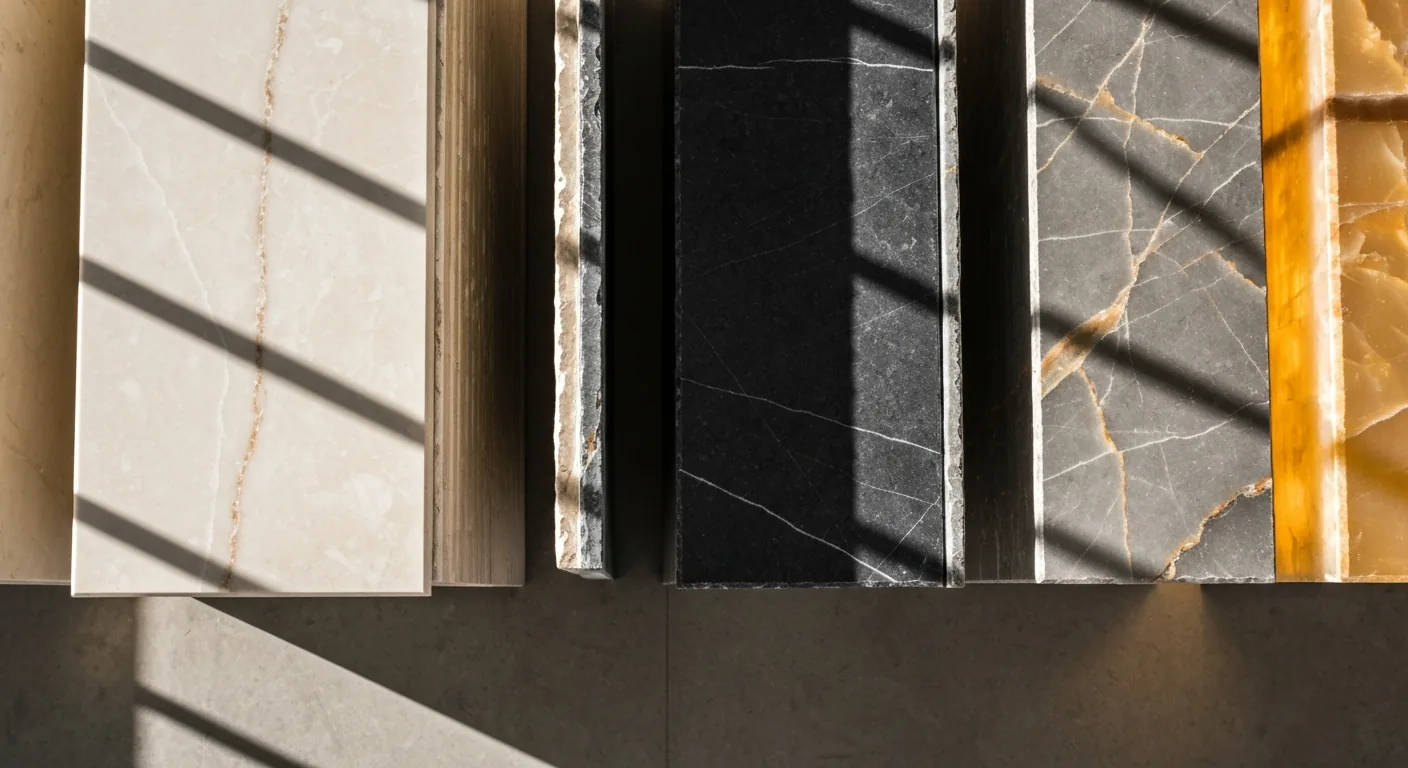
Botticino marble — Pakistan’s light beige variant — commands significant demand from European residential and commercial projects, where warm neutral stone aesthetics dominate specification. Sahara Noir marble is a premium black slab export targeted at high-specification architectural projects in the Gulf and European luxury segment. Fossil Black marble carries a distinct geological identity separating it from commodity Pakistan Black — its fossilized organism inclusions create a visual differentiator that resonates with design-led buyers in Europe and North America. Pakistan Black marble remains the benchmark export variety, available across a commodity-to-premium range depending on finish and dimensional precision.
Quality Segmentation: Raw Blocks vs. Calibrated Slabs vs. Cut-to-Size
Raw block exports represent the lowest-cost entry point but require downstream fabrication investment by the buyer. Calibrated slab exports — typically 18–30mm thickness, surface-finished to polished, honed, or brushed specifications — compress the supply chain and carry the 30–60% price premium referenced above. Cut-to-size tiles and custom-dimension pieces represent the highest-value export form, requiring exporter-side precision cutting and dimensional quality control. The ±1.5mm thickness tolerance threshold is non-negotiable for European and Gulf market acceptance on calibrated slab orders. Buyers should specify marble slab finish type and dimensional tolerance in every RFQ to establish baseline quality expectations upfront.
Understanding Export Certifications and Buyer Verification: ISO 9001, Export Licenses, and Documentation
ISO 9001 Quality Management Certification: What Serious Buyers Should Verify
ISO 9001 certification governs consistency across production, finishing, and dimensional tolerance — not just as a marketing credential but as an operational quality management system with audited scope. For buyers evaluating marble exporters Pakistan, ISO 9001 is the baseline shortlisting threshold. Its absence from an exporter’s documentation package is a material risk signal. Buyers should request the certificate directly, confirm the certifying body, and verify the scope covers marble processing and export operations specifically — not a parent entity with a different operational scope.
Export Licenses, Certificate of Origin, and TDAP Compliance
The Pakistan Trade Development Authority (TDAP) administers export licensing and trade facilitation for Pakistani stone exporters. A valid export license confirms legal standing to export under Pakistani trade law. The Certificate of Origin (CoO) is mandatory for customs clearance in most destination markets and required for preferential tariff treatment where applicable. Buyers importing into the EU, UK, or Gulf Cooperation Council markets should confirm CoO issuance capability as a standard due diligence step before initiating contract negotiations.
Documentation Packages: What to Request Before Commitment
- ISO 9001 certificate — confirm certifying body, scope, and current validity date.
- Export license — confirm TDAP registration and active licensing status.
- Certificate of Origin — confirm issuance process and timeline per shipment.
- Thickness certification — confirm ±1.5mm tolerance standard is documented in QC process.
- Packing list templates — confirm slab count, dimensions, weight, and crate specifications are itemized per export container.
- References from prior international buyers — request contact-verifiable references from at least two buyers in your target region.
- Third-party inspection capability — confirm whether the exporter accommodates pre-shipment inspection by independent agencies such as SGS or Bureau Veritas for high-value orders.
Export Logistics Framework: FOB/CIF, Minimum Order Quantities, Lead Times, and Shipping to Key Markets
Incoterms Explained: FOB Karachi vs. CIF Destination Ports
FOB Karachi transfers risk to the buyer at the point of loading onto the vessel at Karachi Port. The buyer assumes freight, insurance, and destination customs responsibility. CIF (Cost, Insurance, Freight) to a named destination port — such as Rotterdam, Felixstowe, Dubai Jebel Ali, or Limassol — transfers those costs to the exporter and simplifies the buyer’s logistics management. For buyers new to Pakistani marble sourcing, CIF provides cleaner cost visibility. Established importers with freight relationships typically prefer FOB for cost control and carrier flexibility.
Minimum Order Quantity (MOQ) Structure and Cost Implications
MOQ structures vary by product form. Raw blocks are typically quoted by the metric ton with lower per-unit MOQ thresholds. Calibrated slabs are quoted per container load — FCL orders (typically 20-foot or 40-foot containers) command the most favorable per-unit pricing. LCL (Less Than Container Load) orders are viable for specialty materials, sample orders, and smaller projects but carry a per-cubic-meter freight premium of 20–40% compared to FCL equivalents. Custom cut-to-size orders carry additional processing lead time and minimum square meter thresholds depending on exporter capacity.
Lead Times by Destination: Europe, UK, USA, Gulf, Cyprus
| Destination Market | Typical Port | Incoterm Basis | Sea Freight Lead Time |
|---|---|---|---|
| Europe (Netherlands/Germany) | Rotterdam / Hamburg | FOB Karachi | 21–28 days |
| United Kingdom | Felixstowe / Southampton | FOB Karachi | 22–30 days |
| Gulf (UAE/Saudi Arabia) | Jebel Ali / Dammam | FOB Karachi | 7–14 days |
| Cyprus | Limassol | FOB Karachi | 14–21 days |
| USA (East Coast) | New York / Savannah | FOB Karachi | 28–45 days |
These lead time ranges reflect FCL sea freight under standard routing. LCL consolidation adds 3–7 days for groupage processing at origin. Customs clearance at destination is buyer responsibility under FOB terms and adds 3–10 business days depending on destination port efficiency and documentation completeness.
CRAFTIMUS: Vertically Integrated Manufacturer-Exporter with Onyx Specialty and Design Services
Factory-Direct Advantage: Quarry to Export under One Operational Structure
CRAFTIMUS Onyx Marble Industries operates as a vertically integrated manufacturer-exporter — controlling quarry sourcing, slab processing, quality inspection, and export documentation under a single operational structure. This model eliminates the intermediary markup layers that characterize trading company supply chains. Buyers dealing directly with CRAFTIMUS access factory-direct pricing with direct accountability at every production stage: from quarry extraction in KPK and Balochistan through to thickness calibration, surface finishing, and pre-shipment inspection. There is no third party absorbing margin between the production floor and the export container.
Onyx Specialization and Architectural-Grade Backlit Slab Processing
Onyx is a semi-precious translucent stone quarried in KPK and Balochistan provinces. Only a limited number of marble exporters Pakistan possess the processing infrastructure to deliver architectural-grade backlit onyx slabs — the precision calibration, resin treatment, and mesh backing required for translucency applications in feature walls, reception counters, and luxury hospitality environments. CRAFTIMUS’s onyx program addresses this capability gap directly. Buyers seeking architectural-grade onyx slabs for backlit installations will find few verified alternatives at this specification level among Pakistani exporters.
Multi-Material Capacity: Marble, Onyx, and Travertine Under Single Export Chain
CRAFTIMUS exports marble slabs, onyx slabs, and travertine from the same processing facility under a single export documentation and logistics chain. For project-scale buyers — developers, fit-out contractors, or stone distributors specifying multiple material types — this consolidation eliminates the coordination complexity of managing separate supplier relationships, export documentation streams, and container schedules. A single FCL container can carry a specification-matched combination of marble and onyx from CRAFTIMUS’s manufacturing facility, with unified packing lists and a single Certificate of Origin. Buyers requiring travertine alongside marble or onyx can consolidate those requirements within the same order.
3D Rendering and Interior Design Collaboration for Architect Workflows
CRAFTIMUS supports architect and interior designer workflows with 3D rendering services and material visualization capability. No competitor currently visible in the SERP for marble exporters Pakistan offers or signals this capability. For specifiers working on design-led projects — where material selection must be visualized within an architectural context before procurement commitment — this service reduces pre-procurement risk and accelerates the specification approval cycle. Precise material specifications, finish options, and slab dimensions are available before initial contact, reducing pre-sales friction for procurement officers who need to justify sourcing decisions to project stakeholders.
Custom cut-to-size processing means buyers receive project-ready material rather than requiring downstream fabrication by a third-party stone shop. This supply chain compression is a meaningful cost and timeline advantage for developers and fit-out contractors managing tight project schedules.
Comparative Exporter Profiles: Verification, Specialization, and Market Positioning
Criteria for Shortlisting: Certifications, Export Volume, Specialization
When evaluating marble exporters Pakistan, apply a consistent shortlisting framework before issuing any RFQ. The criteria below are sequenced by verification priority:
- ISO 9001 certification — confirmed as current, with scope covering marble processing and export operations.
- Export license status — active TDAP registration, not expired or pending renewal.
- Years in operation and export volume — minimum five years with verifiable international shipment history.
- Product specialization — does the exporter offer the specific marble type, slab thickness, and finish you require?
- Custom processing capability — cut-to-size, bookmatching, vein matching, or resin treatment for specialty materials.
- Documentation package completeness — can they provide CoO, packing lists, thickness certs, and inspection reports as standard?
- Contact response time and communication quality — a 48-hour response to an initial inquiry is a baseline operational quality signal.
Profile Framework: JK Marble Company, SEAIR Directory Exporters, and Emerging Players
JK Marble Company presents direct exporter positioning with credible brand signals and references to marble and onyx product lines. Weaknesses include pricing opacity, no publicly available certification documentation, and no product specialization depth accessible before contact. SEAIR’s curated directory provides a third-party neutral listing of multiple Pakistani marble exporters — useful as an initial discovery mechanism but structurally limited by sparse company descriptions, absent certification verification, and no export volume or specialization data. The TDAP government directory carries official credibility but is based on 2021 data, delivered in Excel format, and lacks the product and certification depth procurement officers require for shortlisting decisions.
Verification Gaps in Current Market: What to Verify Before RFQ
The consistent gap across existing directory listings is the absence of verifiable certification data, finish-level product specifications, and supply chain transparency. Buyers who issue RFQs without first verifying ISO 9001 status, export license currency, and documentation package completeness are exposing procurement decisions to supplier-side risk that structured verification eliminates. CRAFTIMUS maintains a complete documentation package — ISO certificate, export license, CoO capability, and packing list standards — available on request before any commercial commitment is required.
Step-by-Step Buying Guide: From Shortlist to RFQ to Contract for International Buyers
The marble exporter sourcing cycle typically spans four to six weeks from initial RFQ to signed contract. Four sequential phases structure the procurement decision: shortlisting and verification (approximately one week), RFQ preparation and submission (three to five days), quotation analysis and logistics negotiation (five to seven days), and sample approval and final commitment (two to four weeks depending on sample lead time and inspection requirements). Buyers who compress or skip earlier phases expose the contract stage to supplier-side risk that structured verification prevents.
Phase 1: Exporter Shortlisting and Verification Framework
Apply the seven-criteria shortlisting framework above. Request ISO 9001 certificates and export license documentation from each candidate before issuing a formal RFQ. Confirm that the certifying body for ISO 9001 is an accredited third-party auditor — not a self-declared certificate. Request at least two verifiable references from prior international buyers in your destination region.
Phase 2: RFQ Preparation and Specification Documentation
A complete RFQ to marble exporters Pakistan must include: material type and marble variety (e.g., Botticino, Sahara Noir, Fossil Black, Pakistan Black); slab thickness in millimeters with tolerance requirement (specify ±1.5mm minimum); surface finish type (polished, honed, or brushed); slab dimensions or cut-to-size specifications; total quantity in square meters or container load equivalent; destination port; Incoterm preference (FOB or CIF); required lead time; and payment term preference (Letter of Credit, T/T with advance deposit, or open account with credit history). An incomplete RFQ generates imprecise quotations that cannot be accurately compared.
Phase 3: Quotation Analysis, Payment Terms, and Logistics Negotiation
Compare quotations on a fully landed cost basis where possible — unit price, freight cost under CIF, documentation fees, and sample costs should all be itemized. Payment terms for Pakistani marble exports typically include 30% advance T/T with balance against Bill of Lading copy, or confirmed irrevocable Letter of Credit for larger orders. FCL commitments generally unlock better per-unit pricing thresholds than LCL equivalents. Negotiate sample approval lead times before committing to production quantities — a 10–15 day sample lead time is standard for most calibrated slab exporters.
Phase 4: Sample Approval, Quality Certification, and Commitment
Before final commitment, confirm that pre-shipment samples represent production-batch material, not showcase pieces. Specify thickness tolerance verification (±1.5mm) and finish consistency as mandatory sample approval criteria. For orders above a single FCL, consider engaging an independent inspection agency — SGS, Bureau Veritas, or Intertek — to conduct pre-loading inspection at origin. Once samples are approved, finalize the commercial invoice, packing list, and Certificate of Origin documentation. Container loading should be documented with photographic evidence and crate manifest. Request the shipping documentation set — Bill of Lading, CoO, packing list, commercial invoice — within 48 hours of vessel departure.
To accelerate response from CRAFTIMUS, submit your material specification, destination port, MOQ requirement, and Incoterm preference via the contact page. Complete specification submissions receive prioritized quotation responses.
Marble Types and Finishes: Selecting by Project Specification and Market Demand
Marble exporters Pakistan segment their product offerings by market demand and regional preference. Understanding these distinctions before issuing an RFQ ensures your specification is matched to an exporter’s actual material and processing capability — reducing the quotation revision cycles that delay procurement timelines.
European and UK Market Preferences: Botticino, Fossil Black, Premium Finishes
European and UK project specifications most frequently align with Botticino marble — Pakistan’s light beige variant — for its neutral warmth and compatibility with contemporary residential and commercial interiors. Fossil Black marble serves a design-led segment in Europe where geological uniqueness differentiates a specification from commodity black stone. Polished finishes dominate premium project specifications; honed finishes are increasingly specified for contemporary commercial environments where anti-slip and low-maintenance characteristics are prioritized.
Gulf and Middle East Positioning: Sahara Noir, Pakistan Black, Polished Maximums
Gulf market specifications for Pakistani marble favor high-gloss polished finishes on large-format slabs. Sahara Noir marble — a premium black variety with refined vein patterning — is positioned for luxury hospitality, high-end residential, and government project specifications across UAE, Saudi Arabia, and Qatar. Pakistan Black in polished 25–30mm thickness is the standard commodity-to-mid-premium specification for commercial construction. Slab thickness of 30mm and above is the norm for flooring applications in high-traffic Gulf commercial developments.
USA and Cyprus Markets: Mix and Customization Demand
USA and Cyprus buyers typically specify a higher proportion of custom cut-to-size and mixed-material orders. Onyx for backlit feature walls paired with Botticino or Fossil Black marble for surrounding surfaces represents a high-value specification segment where CRAFTIMUS’s multi-material export capability is a direct operational advantage. Travertine — available through the same CRAFTIMUS export chain — serves the rustic-aesthetic segment that maintains consistent demand in North American residential and hospitality projects. Finish types for these markets span polished through brushed, with brushed finishes gaining specification share in the USA boutique hospitality sector. For the complete marble product range serving these markets, see the CRAFTIMUS marble slab catalog.
Quality Control and Grading Standards: What International Buyers Should Expect
Thickness Tolerance and Dimensional Consistency Standards
International buyers should specify ±1.5mm thickness tolerance as a contractual minimum in all purchase orders for calibrated slab exports from Pakistani marble exporters. Dimensional consistency in slab length and width should be specified within a ±5mm range. Surface flatness — measured by a 2-meter straightedge — should not exceed 1mm deviation for polished slab applications. These specifications are aligned with ASTM C503 standard specification for marble dimension stone, which provides an internationally recognized benchmark buyers can reference in export contracts.
Surface Finish Grading: Polished, Honed, Brushed Quality Metrics
- Polished finish — minimum 80-gloss-unit reading on a gloss meter; surface should be free of visible scratches, machine marks, or dull patches across the full slab face.
- Honed finish — uniform matte surface with consistent scratch pattern; no visible residual polish zones or uneven abrading across the slab.
- Brushed finish — consistent linear texture pattern; depth and directionality must be uniform across matched slabs in a batch to ensure visual coherence on installation.
Color Consistency and Vein Pattern Variation Expectations
Natural stone color and vein pattern variation is inherent and cannot be eliminated. However, exporters should grade slabs by color batch and vein intensity range before packing. Buyers should specify acceptable color deviation range — typically Delta E ≤ 3.0 for tight-consistency projects — and require batch photographs from the production run before loading authorization. For bookmatching or vein-matched installations, buyers must communicate sequential slab numbering requirements to the exporter at the RFQ stage, not after production.
Request a Specification Sheet and Export Quotation from CRAFTIMUS
CRAFTIMUS Onyx Marble Industries supplies factory-direct calibrated slabs — marble, onyx, and travertine — to international buyers in the USA, UK, Europe, Cyprus, and the Gulf region. Every quotation is supported by a complete documentation package: ISO 9001 certificate, export license, Certificate of Origin capability, and pre-shipment inspection options.
To receive a precise export quotation, contact CRAFTIMUS directly via the inquiry form. Include your material type (Botticino, Sahara Noir, Fossil Black, onyx, or travertine), required slab thickness and finish, destination port, Incoterm preference (FOB or CIF), approximate quantity or container requirement, and project lead time. Complete specification submissions are processed as priority quotation requests with a target response time of 24–48 hours.
Frequently Asked Questions
What certifications should I verify before committing to a Pakistani marble exporter?
ISO 9001 certification is the baseline quality management credential — confirm the certifying body is an accredited third party and that the scope covers marble processing and export operations. Additionally, verify an active export license through TDAP, Certificate of Origin issuance capability, and the exporter’s capacity to accommodate third-party pre-shipment inspection by agencies such as SGS or Bureau Veritas. Request verifiable references from prior international buyers in your target region before issuing any purchase order.
What is the typical minimum order quantity (MOQ) for Pakistani marble slabs and what pricing advantage exists for FCL orders?
MOQ varies by product form. Raw blocks carry lower per-ton minimums; calibrated slab orders are typically structured around FCL container equivalents — a standard 20-foot FCL holds approximately 18–22 metric tons of marble slabs depending on thickness and packaging. FCL pricing delivers a 20–40% per-unit cost advantage over LCL consolidation. Payment terms are generally negotiable based on volume commitment — higher FCL commitments typically unlock extended credit terms or reduced advance deposit requirements. Contact CRAFTIMUS with your specific quantity and destination to receive a precise MOQ and pricing matrix.
What distinguishes CRAFTIMUS from other Pakistani marble exporters?
CRAFTIMUS operates as a vertically integrated manufacturer-exporter — quarry sourcing, slab processing, quality inspection, and export documentation are controlled under a single operational structure, eliminating intermediary markup. CRAFTIMUS is among the limited number of Pakistani exporters with architectural-grade backlit onyx slab processing capability. Additional differentiators include 3D rendering and material visualization services for architect workflows, custom cut-to-size processing for project-ready delivery, and multi-material export capability covering marble, onyx, and travertine under a single export documentation chain.
How long does sea freight from Karachi take to Europe, UK, and the Gulf region?
Under FOB Karachi terms, typical sea freight transit times are 21–28 days to major European ports (Rotterdam, Hamburg), 22–30 days to UK ports (Felixstowe, Southampton), 7–14 days to Gulf ports (Jebel Ali, Dammam), and 14–21 days to Limassol, Cyprus. USA East Coast destinations (New York, Savannah) range from 28–45 days. These figures apply to FCL shipments under standard routing. LCL consolidation adds 3–7 days for groupage processing at origin, and customs clearance at destination adds further time under FOB buyer responsibility.
What thickness tolerance and finish quality standards should I specify in my RFQ to Pakistani exporters?
Specify ±1.5mm thickness tolerance as the contractual minimum for calibrated slab orders — this is the international buyer baseline aligned with ASTM C503 and European EN 12057 dimensional standards. Specify surface flatness not exceeding 1mm deviation over a 2-meter straightedge for polished applications. For finish quality, require a minimum 80-gloss-unit reading for polished slabs and uniform texture pattern consistency across the batch for honed and brushed finishes. Specify acceptable color deviation (Delta E ≤ 3.0 for tight-consistency specifications) and batch photography before loading authorization.
What should I include in a request for quotation (RFQ) to accelerate response from Pakistani marble exporters?
A complete RFQ should include: specific material type and marble variety (Botticino, Sahara Noir, Fossil Black, Pakistan Black, onyx, or travertine); slab thickness in millimeters with tolerance requirement; surface finish type (polished, honed, or brushed); slab dimensions or cut-to-size specifications; total quantity in square meters or container equivalents; destination port; Incoterm preference (FOB or CIF); required lead time; and payment term preference. Including all of these elements in a single submission eliminates back-and-forth clarification cycles and enables CRAFTIMUS — and any serious exporter — to return a precise, comparable quotation within 24–48 hours.